Anubhuti aur Abhikalp provides variety of contemporary art to enhance both corporate and individual interests.

Art as Reflection: Stories of Life, Society, and the Divine
Rekha Rai’s art captures social struggles, women’s stories, and nature’s beauty with heartfelt intensity.
Anant Rai
5/5/20252 min read
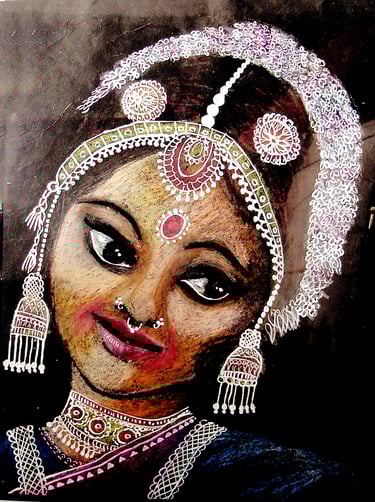
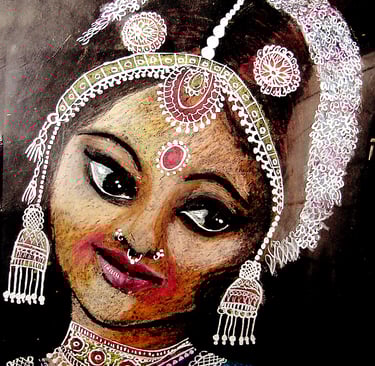
Paintings by Rekha Rai
Art, in its most honest form, reflects life as it is lived—layered with struggle, faith, silence, and resilience. The oil on canvas works of Rekha Rai emerge from this truth, drawing deeply from Indian social realities, rural settings, womanhood, and spiritual devotion to create paintings that speak quietly yet powerfully.
Many of her works confront social challenges and fragile livelihoods. In "Potter’s Dwelling", the life of a village potter mirrors the vulnerability of the clay vessels he shapes—hope and fear balanced within every stroke. Paintings depicting communities below the poverty line symbolically portray hunger, labor, and lost innocence without direct narration, allowing viewers to feel the weight of deprivation rather than merely see it. Folk performers in works like "Nitya Me Racha Jeevan" reveal how art itself becomes survival, where struggle binds performers so deeply to their craft that devotion replaces despair.
The lived experiences of women form the emotional core of Rekha Rai’s canvas. In Mamta and Mamta – 2, motherhood is portrayed not only as unconditional love but also as sacrifice shaped by poverty and societal neglect, where a mother seeks nothing for herself, only dignity and safety for her child. "Pratadit" exposes the painful continuum of exploitation faced by women—from girlhood to old age—while "Lajja" captures feminine grace and modesty as inner strength rather than ornamentation.
Rural womanhood unfolds with quiet realism in works such as "Prateeksha", where waiting becomes a metaphor for longing and endurance, and "Khamosh Aangan", which reveals suppressed emotions hidden beneath routine life, silenced to protect family harmony within a male-led social order. In "Hashra" and its blended compositions, women gather near village lakes or shared spaces, finding brief relief in companionship before returning to the same unspoken struggles—strength renewed, suffering unchanged.
Alongside hardship, Rekha Rai celebrates resilience and shared joy. "Fursat ke Pal" captures village women dancing to rural music, where fleeting moments of leisure restore hope and energy amid lives devoted to labor and responsibility. These scenes affirm that joy itself is an act of survival.
Interwoven with social narratives is a deep undercurrent of spiritual faith and reverence. Paintings of Lord Ganesha, Maa Durga, and Maa Saraswati embody wisdom, protection, and creativity, while symbolic compositions featuring Shiva, the Shivling, Nandi, and the sacred Kalash reflect cosmic balance and devotion. Portraits of national visionaries—Jawaharlal Nehru, Lal Bahadur Shastri, Rajiv Gandhi, Rabindranath Tagore, and Swami Vivekananda—honor leadership, moral courage, creativity, and spiritual awakening.
Guided by a belief in exploring art in its raw, expressive, and truthful form, Rekha Rai uses creativity as a medium for social reflection and transformation, drawing inspiration from nature and the divine to reveal harmony even within hardship. Her paintings encourage viewers to slow down, observe, and feel—to recognize beauty in everyday life, to cultivate empathy and gratitude, and to reflect on equality, justice, and shared humanity.
In Rekha Rai’s world, art becomes more than visual expression—it becomes a silent witness, a gentle question, and a bridge between society, soul, and the sacred.
Contact
Reach out for art inquiries or collaborations
Phone
tribhuvanschoolofaarts@gmail.com
+91-9999037089
© 2025. All rights reserved. No part of this website/application may be reproduced, stored in a retrieval system, or transmitted, in any form by any means, electronic, mechanical, magnetic, optical, chemical, manual, photocopying, recording or otherwise, without the prior written consent of its creator/author The opinions/ contents expressed in this book are solely of the author/Creator and do not represent the opinions/ standings/ thoughts. Anubhuti aur Abhikalp is a brand name under Infity Arts